
Navigating a property settlement during a separation or divorce requires a clear and accurate understanding of the value of your assets. A property valuation is a cornerstone of this process, but not all valuation reports are created equal. The purpose, format, and legal standing of a valuation report can differ significantly depending on whether it is intended for Family Law Court proceedings or for mediation.
Understanding these distinctions is crucial for managing costs, meeting legal requirements, and achieving a fair and equitable outcome.
The Role of a Valuation in Family Law
In any family law property settlement in Australia, the first step is to identify and value the asset pool. This includes real estate or property, businesses, vehicles, and other investments. When parties cannot agree on a property's value during the separation process, an independent valuation is required to establish a fair market price. While a real estate agent’s appraisal can be a useful starting point for informal discussions, it is not a legally binding document and is often disputed. For formal proceedings, a report from a Certified Practising Valuer is essential.
Valuation Reports for Family Law Court
When a property dispute proceeds to the Federal Circuit and Family Court of Australia (FCFCOA), the valuation report becomes a critical piece of evidence. These reports are subject to strict legal and procedural rules.
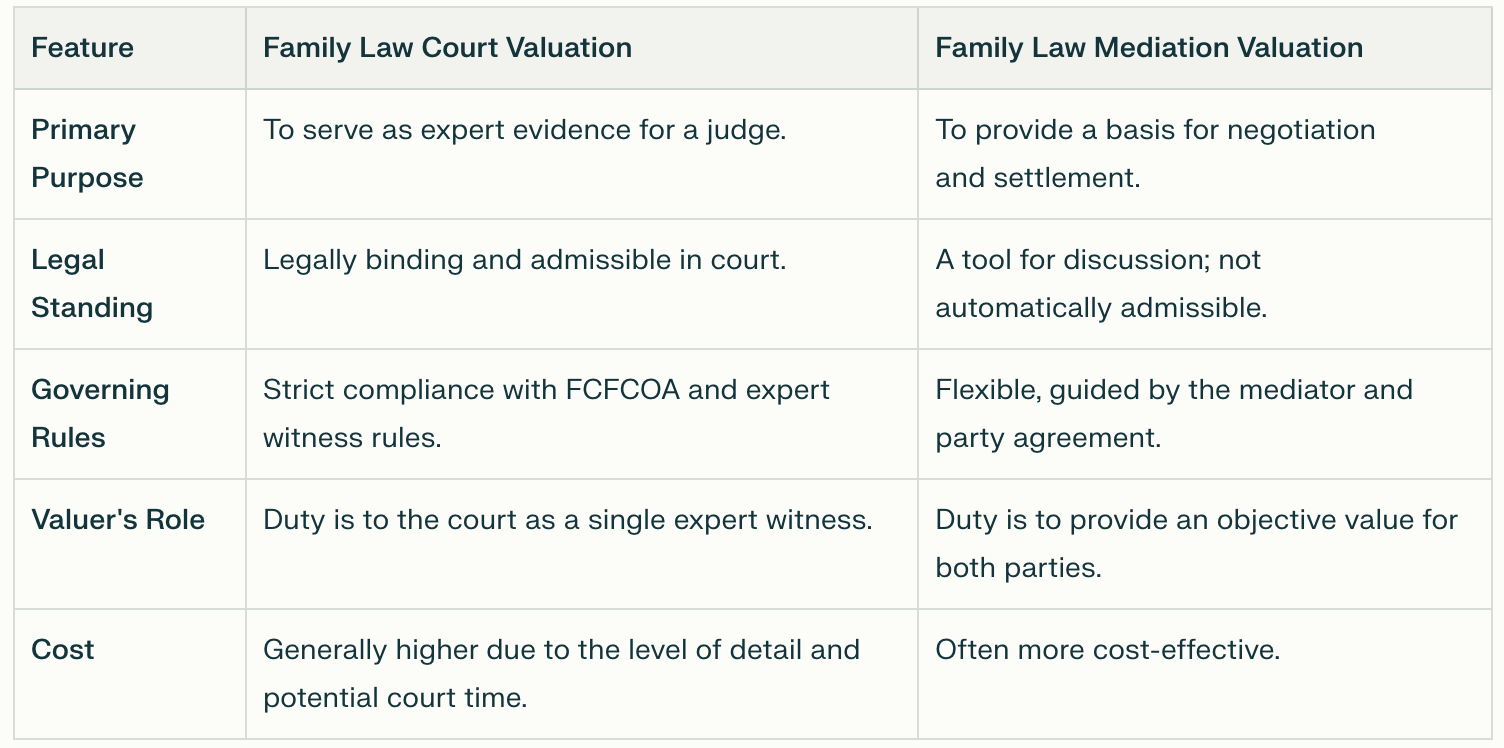
Purpose and Legal Standing: A court valuation report is prepared as expert evidence. Its primary role is to provide the judge with an objective, independent, and defensible opinion of the property's market value. The report must be robust enough to withstand legal scrutiny.
The Single Expert Witness Rule: To ensure impartiality and control costs, the court system strongly prefers a "single expert witness." This means both parties jointly agree on and instruct one valuer to prepare a report. The valuer’s duty is to the court, not to either party. If a party wishes to submit their own separate valuation, they must first seek permission from the court.
Content and Formality: A court-compliant report is highly detailed. It includes a thorough property inspection, analysis of comparable sales, market commentary, risk assessment, and a clear declaration that it complies with court rules. The valuer must be prepared to be cross-examined on their findings in court.
Valuation Reports for Family Law Mediation
Mediation is a less formal, non-adversarial process where a neutral third party helps the separating couple negotiate a settlement outside of court. The valuation report in this context serves a different, more collaborative purpose.
Purpose and Legal Standing: The goal of a mediation valuation is to provide a fair and credible figure that both parties can use as a basis for negotiation. It is a tool to facilitate agreement, not to serve as binding evidence in a legal battle.
Flexibility in Process: While using a jointly appointed valuer is still best practice, the process is more flexible. Parties might each obtain their own valuation and agree to negotiate a value in the middle. The key is transparency and a shared goal of reaching a resolution.
Content and Formality: A mediation report is still prepared by a certified professional to ensure it is accurate and independent. However, it may not need the same level of exhaustive detail and legal declarations required for court. The focus is on providing a clear, well-supported market value that both parties can trust.
Key Differences at a Glance
Conclusion
Choosing the right type of valuation report is a critical decision in any family law property settlement. For matters likely to end up in court, a formal, court-compliant valuation from a single expert witness is non-negotiable. For mediation, a slightly less formal but still certified and independent valuation can provide the foundation for a successful and amicable settlement.
In both scenarios, the expertise of a Certified Practising Valuer who is experienced in family law matters is paramount to ensuring accuracy, compliance, and a fair outcome for all involved.
Read more about Family Law Property Valuations on our Family Law services page.
