
Most Melbourne homeowners have checked what a property website thinks their home is worth. The figure appears instantly, updates regularly and costs nothing.
But an online estimate is a statistical prediction, not a property valuation. It is built from recorded sales data and can differ materially from what the property would achieve on the open market.
For Melbourne owners, the difference matters most when a figure will be used for something with consequences: a family law settlement, a CGT calculation, a duty assessment by the State Revenue Office or an estate distribution.

What is an online property valuation?
An online property valuation is produced by an automated valuation model, orAVM. The software compares the recorded features of a property with recent sales nearby and calculates a likely value.
Most free estimates in Australia come from a few data engines: PropTrack (behind realestate.com.au's realEstimate), Domain's own model, and Cotality, which was known as CoreLogic until its 2025 rebrand.
Each estimate usually comes with a confidence level. A low rating is the model signalling that it had little reliable evidence to work with.
No inspection takes place. The model does not know whether the kitchen is original, whether the apartment faces a wall, or whether a planning overlay restricts the land.
When an online estimate may be useful
An online estimate may help where:
You are curious about broad value trends in your suburb
You are shortlisting properties to inspect
You want a ballpark before talking to agents or lenders
The property is a typical house in an established suburb with plenty of recent sales
It is not designed for purposes that require supportable evidence, such as tax, duty, legal or family law matters. Those generally call for an independent valuation by a Certified Practising Valuer.
Why online estimates can miss in Melbourne
AVM accuracy depends on how much good comparable evidence exists. Where sales are plentiful and similar, estimates tend to be closer. Where they are scarce or varied, errors grow.
This is not only a theoretical concern. A 2026 head-to-head test of two models across about 7,000 Melbourne sales reported typical errors in the tens of thousands of dollars for both of them.
Melbourne has several property types that are hard for software to read:
Victorian and Edwardian homes in Fitzroy, Carlton, Northcote and Williamstown, where renovation and extension quality varies dramatically
High-rise apartments in Southbank, Docklands and Box Hill, where floor level, views, building quality and cladding issues can move value
New estates in growth corridors such as Tarneit, Craigieburn and Clyde North, where resale evidence is limited and many sales were house-and-land packages
Bayside and prestige homes in Brighton, Toorak and Sandringham, where land size and quality of build drive value
Properties under a Heritage Overlay or flood overlay, where planning controls affect what can be done with the land
What does an online estimate miss?
A model works only with recorded data. It typically cannot account for:
Internal condition, fit-out quality and unrecorded renovations
Building defects, moisture or structural issues
Planning zones and overlays under the local planning scheme
Owners corporation fees, special levies and building rectification works
Aspect, outlook, noise and privacy
Easements, covenants or other title restrictions
Leases that affect the value of an investment property
A certified valuer inspects the property, reviews these matters and chooses comparable sales by professional judgement.
How to check an online estimate
1. Look atthe confidence rating
If the estimate is marked low or medium confidence, treat it as indicative only.
2. Compare more than one source
Check estimates from at least two different data engines. A large spread tells you the model is uncertain.
3. Review the comparable sales
Where sales are listed, check they are truly comparable. A renovated Victorian in Northcote is not a good comparison for an unrenovated one on a main road.
4. Allow for whatthe model can't see
Factor in condition, recent works, defects and overlays that the model has no record of.
5. Get an independent valuation when it matters
For any legal, tax or financial purpose, obtain a formal valuation report.
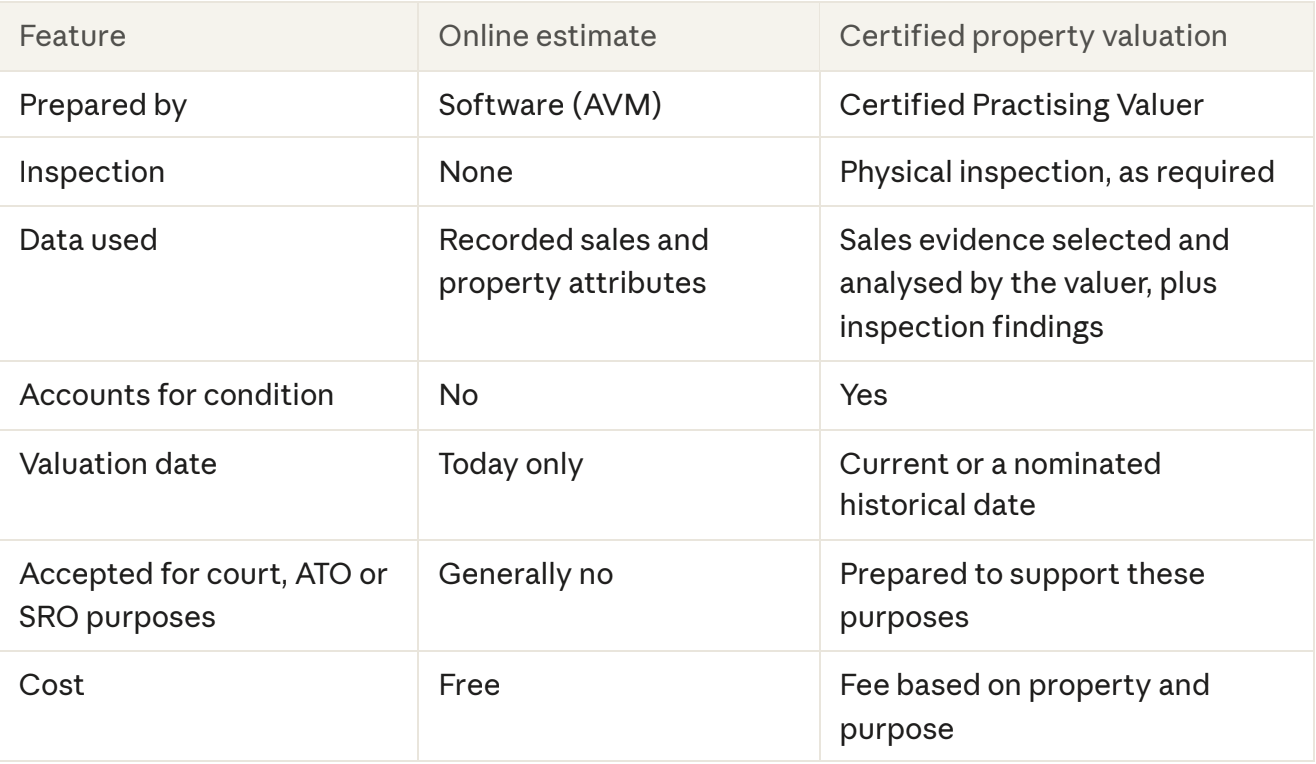
Online estimate versus certified valuation
Your rates notice CIV is not a market valuation either
Many Melbourne owners also look at the Capital Improved Value (CIV) on their council rates notice. In Victoria, the Valuer-General values every property each year, as at 1 January, for council rates and land tax. The notice also shows the Site Value, which is the land only.
These are mass statutory valuations prepared for rating, not for a sale, settlement or tax calculation. By the time the notice arrives, the market may have moved, and an individual property's features may not be fully reflected.
When an online estimate and a valuation disagree
A certified valuation will often land some distance from the figure shown online. That is not a sign that either is careless. The two are built on different information and answer different questions.
Take a double-fronted Edwardian weatherboard in Coburg. The online model may know its land size, bedroom count and the price it sold for in 2014. It will not know that the house has since been restumped, extended at the rear with a second living area and given a north-facing deck. Nor will it know that the comparable sale two streets away backed onto a busy rail line. A valuer who inspects the property and analyses the evidence can account for both. The model cannot.
It can work the other way too. In some Southbank and Docklands towers, online estimates have been anchored to earlier sales in the same building that may no longer reflect what buyers will pay, particularly where a building has had defects, cladding works or a rise in owners corporation fees.
If your valuation and an online figure differ, it helps to ask:
Which comparable sales did each figure rely on?
Does the valuation explain its adjustments?
Was the property inspected, and are its improvements recorded correctly?
Do both figures apply to the same date?
Information that helps a valuer
When ordering a valuation in Melbourne, the most useful information to have ready is
often:
Building permits and certificates of occupancy for extensions or additions
Renovation invoices, plans and photographs
The Section 32 vendor statement, if the property was recently bought
Owners corporation certificates, minutes and fee notices for apartments and units
Current leases and rent statements for investment properties
The purpose of the valuation and the date it must apply to
Supplying this at the time of instruction generally leads to a faster and better-supported report.
Frequently asked questions
Are online property estimates accurate in Melbourne?
They can be close for typical houses in established suburbs with many recent sales. They are less reliable for apartments, heritage homes, renovated properties and new estates.
Is the CIV on my rates notice the market value of my home?
Not necessarily. The CIV is a statutory valuation for rating purposes as at 1 January. It is not prepared for a sale, family law, CGT or duty purpose.
Why is my apartment estimate so different between websites?
Apartment values depend on floor level, outlook, building quality and owners corporation matters that models rarely capture. A wide spread between sites reflects that uncertainty.
Can I use an online estimate for a family or related-party transfer?
Generally no. A transfer between related parties may require duty to be assessed on market value, and the State Revenue Office may ask for supporting evidence. A stamp duty valuation is the safer approach; confirm with your conveyancer or accountant.
Do lenders rely on online estimates?
Lenders may use automated valuations for some lower-risk loans. For higher-value, unusual or higher-risk lending, they will usually order a valuation from a valuer on their panel. Either way, that valuation is prepared for the lender and is not designed for your tax, duty or family law purposes.
Does ValueMax value properties in regional Victoria?
Yes. ValueMax provides valuations across Melbourne and regional Victoria, subject to the property type and location of the instruction.
Need an independent property valuation in Melbourne?
If you need a reliable market value for a sale, purchase, family law matter, CGT, duty or estate purpose, contact ValueMax Property Valuers for a certified valuation across Melbourne and regional Victoria.
